How Ingredient Blenders Build an Approved Supplier File for Enzyme Inputs
For a contract food ingredient blender, enzymes are rarely just another line item. They can influence blend performance, customer label expectations, rework exposure, allergen review, release timing, and the credibility of your technical file. That is why bulk food enzyme sourcing for ingredient blenders should start before the purchase order. It starts with an approved supplier file that procurement, quality, regulatory, and production can all use without friction.
The strongest files do not read like a stack of PDFs collected after a rush order. They read like a sourcing control system: who is approved, what enzyme inputs are covered, which documents are current, what substitutions are permitted, which pack formats are validated for your plant, and what happens when a lot changes.
BatchLoom supports ingredient blenders that need enzyme sourcing to be consistent, documented, and commercially usable at bulk scale.
Why enzyme supplier approval deserves its own discipline
Many blenders already have a supplier approval process for carriers, sweeteners, proteins, starches, acids, gums, flavors, and processing aids. Enzyme inputs add a different layer of risk because they are often purchased for functional performance rather than simple identity.
A blender may need enzyme inputs for bakery premixes, dairy systems, beverage preparations, grain processing blends, protein modification systems, digestive ingredient blends, or specialty food manufacturing formulations. In each case, procurement has to align availability and price with quality expectations that are more technical than a commodity powder.
A good approved supplier file helps answer practical questions:
- Can this supplier support recurring bulk demand without changing the input profile unexpectedly?
- Are certificates, specifications, allergen statements, and origin documents current and usable for customer review?
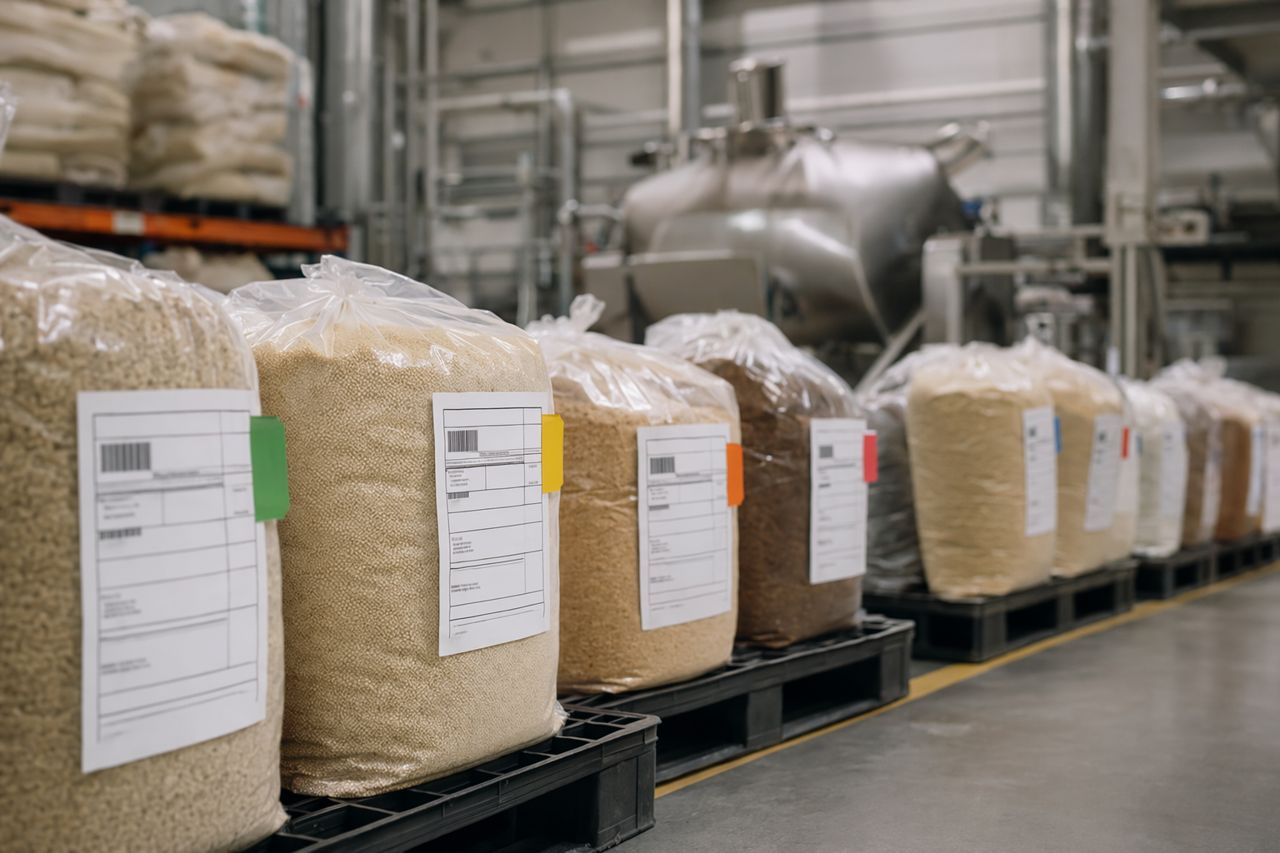
- Are the pack sizes, labels, and pallet configurations compatible with our receiving and batching workflow?
- Can the supplier maintain lot traceability across repeat orders?
- What is the substitution pathway if a customer order is time-sensitive?
- Does the commercial offer reduce risk, or simply lower the visible unit price?
Start with the enzyme use case, not the vendor name
The file should begin with the functional role of the enzyme input in your blending program. This prevents procurement from approving a supplier that looks acceptable on paper but does not fit the application reality.
For each enzyme input, define:
- Enzyme category or function required
- Target food application or blend family
- Required physical form, such as powder, granulate, or liquid
- Carrier and diluent constraints
- Allergen, dietary, and customer-specific restrictions
- Declared performance band required for the formulation
- Packaging format and minimum usable shelf life on receipt
- Storage and handling requirements
- Whether equivalent substitutions are allowed
This lets sourcing managers evaluate suppliers against the actual blend need. It also helps quality teams review supplier documents with context, instead of treating every enzyme document packet as interchangeable.
Build the document set before the first production order
The approved supplier file should contain the documents your team needs before an enzyme input reaches receiving. The exact list depends on your customer base and certification program, but most contract blenders should expect a controlled document set.
Core supplier documents
- Supplier approval questionnaire or vendor profile
- Food safety certification or audit summary, where applicable
- Product specification sheet
- Certificate of analysis format sample
- Safety data sheet
- Allergen statement
- Country of origin statement
- Ingredient composition or carrier declaration, as permitted
- Non-GMO, vegan, kosher, halal, or other program statements when required
- Shelf-life statement
- Storage and handling guidance
- Lot traceability statement
- Change notification policy
- Recall and complaint contact procedure
The goal is not to collect documents for the sake of a folder. The goal is to make sure the supplier can support your customers’ documentation expectations quickly, repeatedly, and without avoidable gaps.
Review the specification like a blender, not a broker
Ingredient blenders need specifications that work on the production floor. A document may look complete and still fail your operating requirements.
Review the specification for:
- Particle behavior relevant to dry blending
- Flowability and dusting considerations
- Visual appearance and color tolerance
- Odor profile where it may affect finished blends
- Carrier compatibility with your formulation and customer label
- Moisture sensitivity and storage implications
- Pack integrity and reseal expectations
- Declared performance band and acceptable variation
- Documented shelf life under normal storage conditions
For dry ingredient blending, physical handling matters. A technically suitable enzyme input can create batching inefficiency if it bridges, dusts heavily, segregates, or requires unusual handling controls. The approved supplier file should capture these observations so procurement does not optimize price while production absorbs the disruption.
Make lot consistency a commercial requirement
Bulk enzyme purchasing is not only about access to volume. It is about predictable lots that behave consistently enough for your blend families and customer specifications.
Your supplier file should define what your business expects around lot consistency:
- Standard certificate of analysis fields
- Lot coding and traceability format
- Expected document turnaround time after shipment
- Pre-shipment document availability for urgent orders
- Shelf-life minimum at delivery
- Retained sample policy, if available
- Advance notice for changes in manufacturing site, carrier, source material, or specification
- Complaint response timeline
These points belong in the sourcing conversation before price is finalized. They affect the real cost of ownership, especially when a delayed document can hold a finished blend from release.
Control substitution risk before you need a substitute
Substitution risk is one of the most underestimated issues in enzyme sourcing. A buyer may find an alternate enzyme input that appears commercially attractive, only for quality or R&D to reject it because the carrier, label status, allergen profile, or performance profile does not fit the customer formula.
An approved supplier file should include a substitution map:
- Primary approved enzyme input
- Conditionally approved alternates
- Customer accounts or blend families where alternates are not allowed
- Required internal review before substitution
- Documents required for alternate release
- Label and allergen checks required before use
- Production trial or blending observation notes, if applicable
This protects procurement during shortages. It also keeps the company from making emergency decisions in the middle of a customer delivery window.
Align bulk pricing with documentation and service levels
Bulk pricing matters, but ingredient blenders should avoid evaluating enzyme offers as if every quote carries the same operational value. A lower price can become expensive if it brings inconsistent lead times, incomplete documents, limited pack options, or uncertain change control.
When comparing suppliers, include service terms in the commercial review:
- Bulk price breaks and committed-volume options
- Standard lead time and realistic rush-order capability
- Pack size options for your batch sizes
- Mixed-pallet or multi-enzyme ordering flexibility
- Minimum order quantity and inventory planning implications
- Document response time
- Forecasting support
- Availability of reserved or planned inventory
The right enzyme supplier helps procurement plan. The wrong one forces procurement to chase.
What quality should verify before approval
Quality review should not be reduced to checking whether documents exist. It should verify whether those documents are current, internally consistent, and usable for your customers’ technical review.
Recommended checks include:
- Product name, code, and description match across documents
- Specification aligns with certificate format
- Allergen and dietary statements do not conflict with carrier information
- Origin and manufacturing information meet customer requirements
- Shelf-life and storage conditions are practical for your inventory cycle
- Change notification language is clear enough for customer commitments
- Lot traceability process supports your recall program
If your customer base includes brands with strict documentation portals, retailer requirements, or export review, make those requirements part of supplier approval from the beginning.
What procurement should verify before approval
Procurement should test whether the supplier can perform beyond the sample stage. Many sourcing problems appear only after the first repeat order.
Before approval, confirm:
- Repeat availability of the enzyme input
- Lead time stability under normal demand
- Bulk order pricing structure
- Pack size and pallet configuration
- Shipping lanes and temperature exposure considerations where relevant
- Communication responsiveness
- Ability to support forecasted demand
- Clear escalation path for shortages or document delays
A supplier that responds quickly during qualification but slowly after award can create internal friction. Procurement should evaluate communication quality as part of supplier approval.
Organize the file for fast internal use
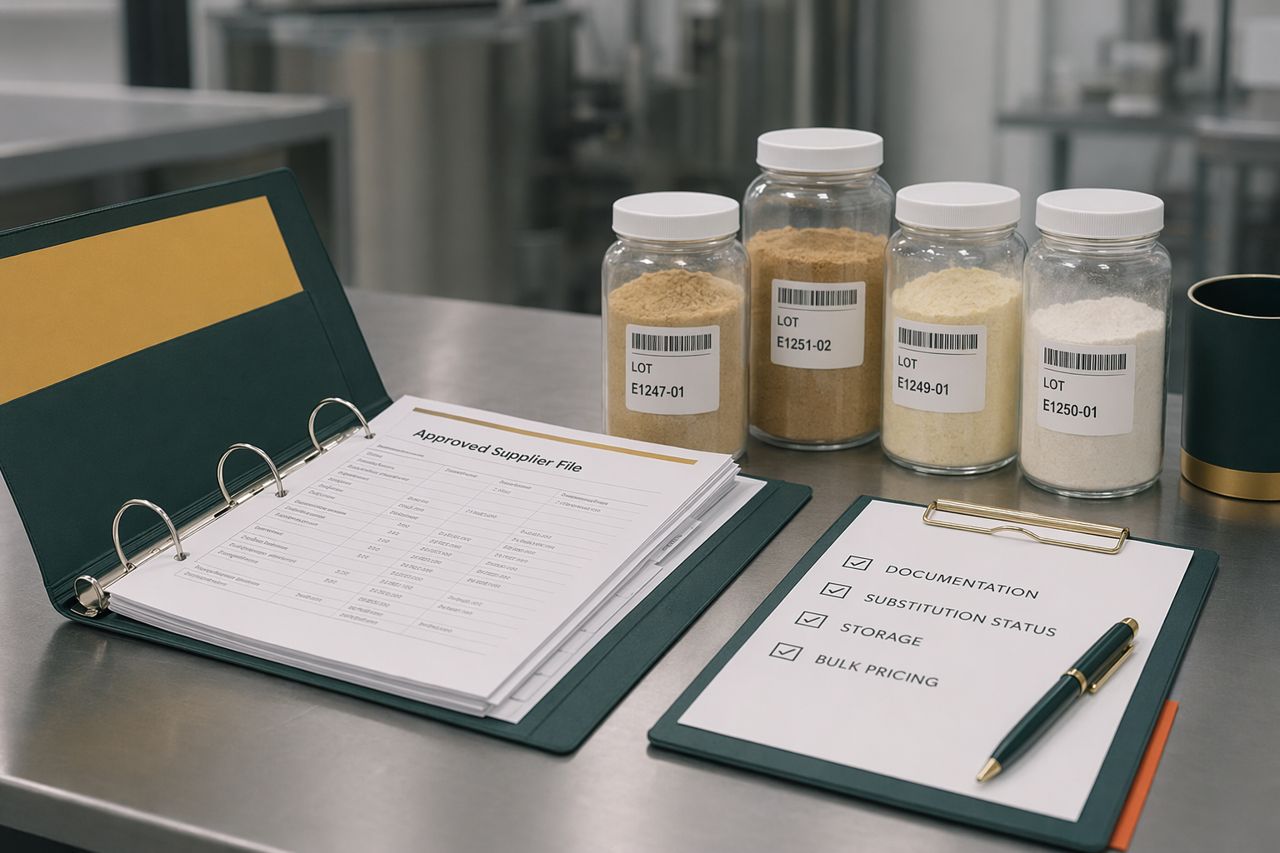
An approved supplier file should be easy to use during a live order. Consider organizing it into four sections:
1. Commercial approval
Vendor profile, payment terms, pricing structure, pack sizes, lead times, minimum order quantity, and reorder contacts.
2. Technical approval
Product specifications, declared performance band, physical form, carrier information, application notes, and internal fit assessment.
3. Quality and regulatory approval
Food safety documentation, allergen statements, dietary declarations, origin statements, safety data sheets, certificate templates, and change notification policy.
4. Operational notes
Receiving instructions, storage requirements, lot coding observations, blending behavior, substitution restrictions, and customer-specific limitations.
This structure allows procurement, quality, and operations to find what they need without re-reading the entire file.
Red flags during enzyme supplier approval
Watch for signals that may create future disruption:
- Vague product descriptions or inconsistent naming across documents
- Reluctance to disclose carrier or composition information at an appropriate level
- Certificates that do not match the specification format
- Unclear allergen or dietary statements
- No defined change notification process
- Unstable lead time answers
- Pack sizes that do not fit your batching reality
- Limited traceability detail
- Pricing that depends on uncertain availability
- Slow response to documentation questions during qualification
These issues may not disqualify a supplier automatically, but they should trigger deeper review before approval.
Where BatchLoom fits
BatchLoom works with contract food ingredient blenders that need enzyme inputs sourced with the discipline of a production-critical ingredient. We help buyers evaluate enzyme options, compare supplier documentation, plan bulk purchasing, and reduce substitution risk across repeat orders.
Our role is practical: support approved supplier development with clear product documentation, bulk sourcing conversations, lot-aware supply planning, and quote support that reflects how ingredient blenders actually buy.
If your team is building or updating an approved supplier file for enzyme inputs, we can help you define the commercial and documentation requirements before the next order becomes urgent.
Request a quote for enzyme inputs
Ready to review bulk options for an approved supplier file? Use the on-site request a quote form and include the enzyme category, intended food application, preferred physical form, target pack size, documentation requirements, and forecasted order timing.