Bakery and Cereal Premix Enzyme Sourcing: the Blender's RFQ File
If you run purchasing or QA at a contract blender, the enzyme is a small line in the bakery improver or cereal premix, but it is the line that decides whether the customer's loaf behaves the same next month. This page is the file we ask blenders to keep for every enzyme input: what each enzyme does in the premix, what to put in the request, why two offers rarely compare, and how to qualify a second source without a reformulation.
One enzyme, five bases: why "bakery enzyme" is not a specification
A single xylanase is marketed for bread, noodles, steamed buns, biscuits and rice-flour industrial premix, and in the same breath for compound improver production, where the blender is the customer. The same xylanase family is sold as an improver input for bread and steamed buns for factory use. Ready improvers go the other way: a noodle-specific compound baking enzyme is sold as its own use-specific kit in a 1 kg pack, one product per base. The mistake blenders make is to buy one grade and spread it across all five bases; bread, steamed bun and biscuit each want a different balance of enzymes, and the offer rarely says which one it was built for.
What each enzyme does inside the premix
Fungal alpha-amylase and maltogenic amylase are two different purchases: the fungal type is for flour correction, faster proofing and oven spring, while the maltogenic type is for anti-staling and crumb softness. Asking a supplier for "alpha-amylase" without naming the job is the first reason an offer comes back wrong. For regular industrial bread, the sensible route is a maker of baking enzymes or its B2B channel, not a laboratory-chemical shop, and the most concentrated or most heat-stable amylase is not automatically the right one; it depends on the flour, the dough process and the freshness the customer wants.
Maltogenic amylase earns its place in a premix as the freshness enzyme: it slows the ageing that turns bread dry and is strongest when it works in synergy with the other baking enzymes in the blend. Bread waste is driven as much by ageing as by spoilage, which is why a blender should treat the maltogenic dose as a shelf-life lever, not a volume lever.
Xylanase works on the hemicellulose in dough, and its promise to the blender is extensibility and fermentation tolerance in bread and steamed-bun systems.
Lipase is positioned as the clean-label swap for chemical emulsifiers: the bakery press puts its carbon footprint at 14x lower than DATEM, cites a 10% footprint cut for the process, and counts 30 billion bread units a year made with lipase products. Enzymes act during mixing, proofing and the early bake and lose their activity in the oven, so in many markets they are treated as processing aids; a blender who expects the lipase to keep working in the finished loaf has misread what it buys. Glucose oxidase is bought for volume, structure and resistance to over-fermentation, and the comments under a maker's demonstration are a buyer queue: "Where did you buy the glucose oxidase?", "I am looking for enzymes for tortilla wraps", and a plain request for the supplier's contact. That demand usually has no buying path, which is exactly where a blender with a qualified premix steps in.
Comparison: enzyme, job, failure when misspecified, what the RFQ must state
| Enzyme in the premix | Job it is bought for | Typical failure when the request is vague | What to state in the RFQ |
|---|---|---|---|
| Fungal alpha-amylase | flour correction, proofing speed, oven spring | supplier ships a maltogenic grade or vice versa; volume target missed | the job (proofing vs anti-staling), powder or liquid, dose target |
| Maltogenic amylase | anti-staling, crumb softness, less bread waste | dosed as a volume enzyme; freshness claim not met | shelf-life target in days, synergy partners already in the blend |
| Xylanase | extensibility, fermentation tolerance in bread and steamed-bun bases | one grade bought for five bases; activity not stated | the base (bread, bun, noodle, biscuit), activity in U/g with its assay |
| Lipase | emulsifier replacement, softness, shelf life | expected to act after baking; treated as a labelled additive | the emulsifier it replaces (for example DATEM), footprint claim if the customer asks |
| Glucose oxidase | volume, structure, resistance to fermentation | offers quoted without activity; price per kg compared blind | activity in U/g or U/mg, moisture, carrier, dose per job |
| Ascorbic acid (non-enzyme partner) | gluten strength, finer crumb | assumed to deliver softer-for-longer; that claim is unproven in practice | keep it on the flour-treatment side of the file, not the enzyme side |
Why two offers almost never compare
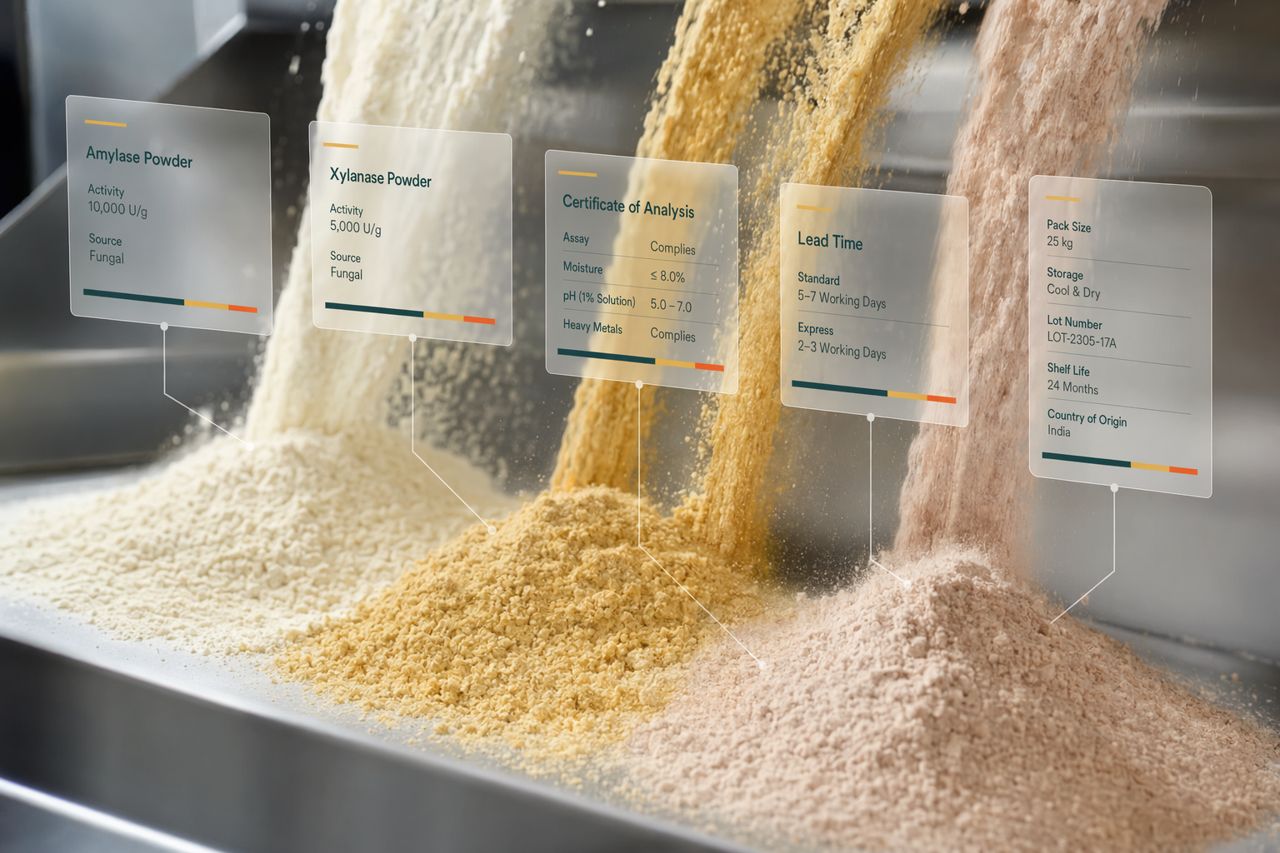
The most common failure is an offer with no activity on it. Published glucose oxidase offers range from a 25 kg pack to MOQs of 100 kg and 1 t, some state activity as at least 100 or at least 200 U/mg and others state nothing, so a price per kilogram compared across them is meaningless. To compare two offers you line up U/g or U/mg, moisture, carrier, the activity definition and the dose your premix needs, and only then the commercial terms. A dose from another industry is a trap: the same glucose oxidase is dosed at 5-15 ppm for juice deoxygenation and shipped in a 28 kg pack, numbers that tell a bread blender nothing about its own premix. The second failure is the grade problem described above: a general bakery xylanase sold for bread, noodles, buns, biscuits and premix production at once, with no statement of which base it was tuned for.
Downstream of the blender, the dosing confusion is worse, and it lands on your customer service desk. Under a 1:50 bread-improver video the questions are "2 tbs of bread improver for every 3 cups?", how much improver per cup of flour, and what separates a bread enhancer from a bread improver. Under a baking-with-enzymes talk the question is whether amylase goes in at the start of fermentation or into the final dough. A premix label that states the dose as grams per 100 kg flour at a named activity, with the addition point, removes both questions before they are asked.
The RFQ: what to send so the offer comes back comparable
- The enzyme and the job: fungal alpha-amylase for proofing and flour correction, or maltogenic amylase for anti-staling, never just "amylase".
- Target activity or target dose, and whether you blend powder or liquid.
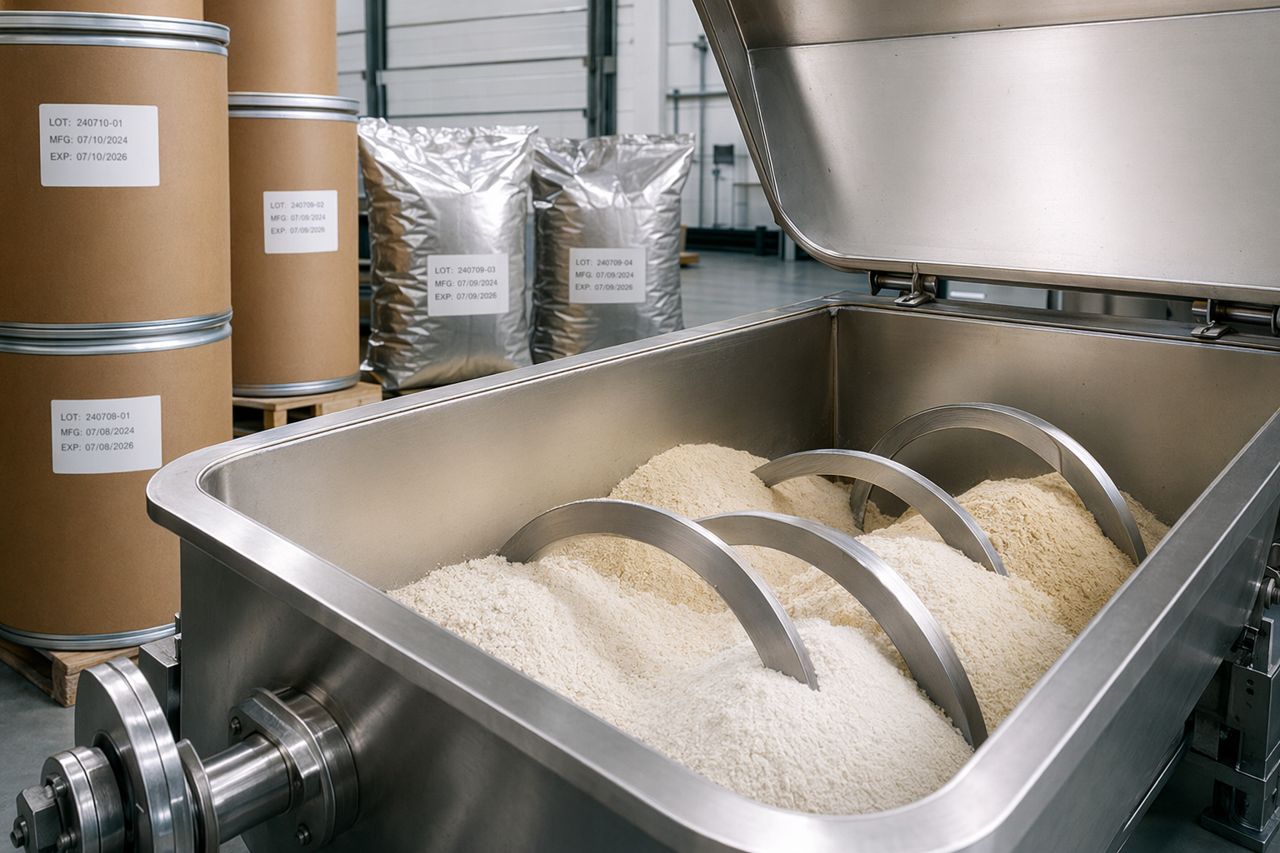
- Pack size, normally 25 kg for a dry-blend line, and your monthly or yearly offtake in kg, for example 100 kg, 500 kg or several tonnes a month.
- Delivery rhythm, and the source organism you have approved, such as Aspergillus oryzae or a Bacillus strain.
- Ask for the temperature and pH activity curve, and the allergen and GMO statements your customer file needs, as documents where available rather than assumed.
- For glucose oxidase and any oxidase, the activity unit (U/g or U/mg), moisture and carrier, because without them the offers cannot be ranked.
- The base the premix is built for (bread, steamed bun, noodle, biscuit), because a grade sold for all of them at once is not a grade for yours.
- The enzymes already in the blend, since maltogenic amylase is sold on its synergy with the other baking enzymes and the supplier should know what it will sit next to.
With those eight lines a supplier can return a short list of 3-5 fitting products with pack, documents and route to quote; without them you get a catalogue.
Qualifying a second source without a reformulation
- Match the job, not the name: a second-source "alpha-amylase" that is maltogenic where the first was fungal is a different ingredient and the customer's proofing will shift.
- Match activity on the same assay, then re-dose: the second source may need a different gram figure for the same U per 100 kg flour, and that figure belongs on your blend sheet before any trial.
- Trial at the customer's process, because the right amylase depends on flour, dough process and desired freshness, not on how concentrated or heat-stable it is.
- Check the label consequence: in many markets enzymes are treated as processing aids; check the labelling rule in the customer's market. Emulsifiers and flour-treatment agents carry E-numbers and must be declared; a swap from lipase back to an emulsifier changes the customer's label.
- Keep the improver as a balanced mixture in your records: emulsifiers, enzymes and flour-treatment agents each interact with the flour, so one swapped component shifts the balance of the rest.
- Separate the enzyme claims from the non-enzyme claims: ascorbic acid tightens the crumb and lifts oven spring, and one baker reported the same result at 1 g in 650 g of dough, but the "softer for longer" claim is not something the same creators could confirm.
Failure cases we see in blender files
- Offer accepted with no activity stated, then the second lot arrives at a different strength and the premix dose is wrong.
- One xylanase grade bought for bread, bun, noodle and biscuit premixes at once.
- Lipase expected to keep conditioning after the bake, when enzyme activity is lost in the oven.
- Dosing instructions in spoons and cups copied from a consumer video instead of grams per flour weight.
- A shelf-life promise built on ascorbic acid rather than on the maltogenic amylase.
- Enzymes are denatured during baking, and in many markets enzymes are treated as processing aids; check the labelling rule in the customer's market before a label review lists them as additives.
- An improver bought as one ingredient when it is a balanced mixture of emulsifiers, enzymes and flour-treatment agents.
Next step
Email us your premix spec sheet, the base it is built for and your monthly volume, and we reply with a short sourcing sheet, a sample plan and the eight-line RFQ filled in for your enzyme inputs. If you already hold an approved grade and need a second source, send us the current spec sheet and we return a like-for-like comparison with the re-dose figure.